

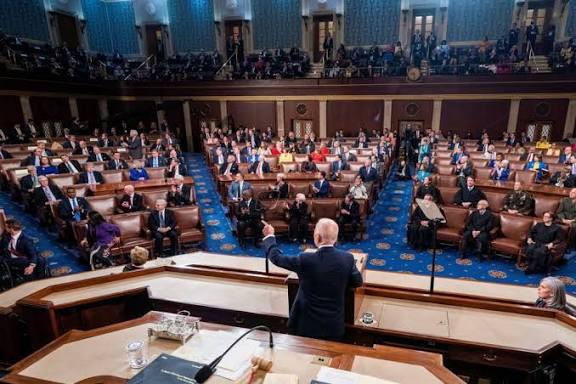
A heated debate erupted in the United States Congress on Thursday as lawmakers sharply disagreed over the nature of Nigeria’s worsening insecurity, following recent mass kidnappings and heightened global scrutiny.
The tension follows former U.S. President Donald Trump’s decision to redesignate Nigeria as a Country of Particular Concern (CPC)—a classification linked to religious freedom violations. His successor, President Joe Biden, had removed Nigeria from the list, but Trump reinstated it last month and further threatened potential military action against the country.
At Thursday’s congressional hearing, legislators were strongly divided. While some framed the situation as a “Christian genocide,” others warned against oversimplifying Nigeria’s overlapping crises of terrorism, banditry, and communal violence.
One of the leading voices pushing the genocide narrative, Congressman Riley Moore, met in Washington on Wednesday with a high-powered Nigerian delegation led by National Security Adviser Nuhu Ribadu. Moore described the meeting as “frank, honest, and productive,” saying discussions focused on counterterrorism assistance, security support, and the protection of vulnerable communities.
The Nigerian delegation included key figures such as Minister of State for Foreign Affairs Bianca Odimegwu-Ojukwu, Inspector-General of Police Kayode Egbetokun, Attorney-General of the Federation Lateef Fagbemi (SAN), Chief of Defence Staff Gen. Olufemi Oluyede, Chief of Defence Intelligence Lt.-Gen. E.A.P. Undiandeye, and other senior defence and diplomatic officials.
During the congressional session, Democratic Representative Sara Jacobs of California strongly criticised Trump’s threat of unilateral military action in Nigeria, calling it “reckless” and dangerous for communities already under severe pressure from armed groups.
Jacobs cautioned against reducing Nigeria’s complex insecurity to a religious battle, arguing that both Christians and Muslims are victims of violence. She referenced the recent killings and church abductions in Eruku, Kwara State, as well as the kidnapping of 25 schoolgirls in Kebbi State, to illustrate the multi-layered nature of the crisis.
The congressional hearing comes amid intensified international attention on Nigeria following a string of high-profile attacks, including the kidnapping of over 200 pupils from a Catholic school in Niger State earlier this week.