

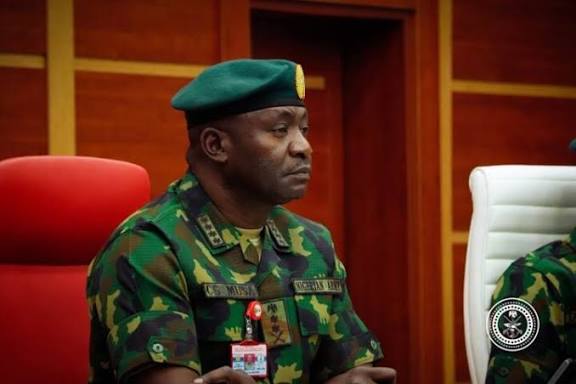
Musa, who made the remarks during his ministerial screening before the Senate in Abuja, said insurgents used ransom proceeds to regroup, re-arm and launch fresh attacks, adding that communities that previously negotiated still suffered renewed assaults.
“There must be no negotiation with criminals. Paying ransom only buys terrorists time to reorganise. Nigeria’s banking system is capable of digitally tracking illicit financial flows if fully optimised,” he said.
The Defence Minister-designate argued that Nigeria’s security challenges would persist unless the country established a unified national database linking all banking, identity and security systems. According to him, the current fragmented data architecture—spread across immigration, quarantine services and other agencies—creates loopholes exploited by terrorists, kidnappers, cyber-criminals and illegal mining syndicates.
‘Kinetic Efforts Alone Cannot Win the War’
General Musa noted that military operations contribute only 25–30 per cent of counter-insurgency efforts, insisting that poverty, illiteracy and weak governance structures at the grassroots continue to fuel criminality. He urged state and local government authorities to take greater responsibility for intelligence gathering and early intervention.
He expressed frustration with Nigeria’s slow justice system, arguing that prolonged terrorism trials weaken the morale of security personnel. He recommended the establishment of special terrorism courts, accelerated hearings and stronger penalties.
On maritime security, Musa warned of rising sea robbery and renewed piracy along the Akwa Ibom–Cameroon corridor, adding that Operation Delta Safe had been expanded to cover new hotspots. He also demanded an immediate ban on illegal mining, describing it as a major financial lifeline for armed groups.
The minister-designate disclosed plans to withdraw soldiers from routine checkpoints and redeploy them to deep-forest operations to reclaim ungoverned spaces and restore safe access to farmlands. He emphasised food security as a critical pillar of national stability, saying: “A hungry man is an angry man. Protecting farmers means protecting the nation.”
House of Reps Calls for Transparent Terrorism Trials
Meanwhile, the House of Representatives, after a three-day special debate, adopted far-reaching national security reforms, including a call for open and transparent prosecution of all terrorism-related cases.
Lawmakers argued that secret trials weaken public confidence and obscure accountability. They recommended fiscal, intelligence, judicial and operational reforms, including a Joint Intelligence Fusion Centre, expanded anti-kidnap fusion cells, border security upgrades using drones, satellite imaging and AI-enabled analytics, and improved welfare for security personnel.
They commended President Bola Ahmed Tinubu for recruiting 20,000 additional police officers, redeploying VIP-attached personnel to core duties and prioritising domestic security over foreign engagements.
Witness Protection, Political Will Dominate Reactions
Human rights lawyer Evans Ufeli, reacting to the Reps’ proposal for open terrorism trials, warned that witnesses could be targeted unless their identities and voices are shielded. Another activist, Deji Adeyanju, criticised what he described as insincere political commitment to the fight against terrorism, arguing that some politicians still maintain ties with armed groups.
However, lawyer Inibehe Effiong supported open trials, insisting they promote transparency and give victims a sense of justice, provided witness protection frameworks are in place.
Senate Moves Toward Death Penalty for Kidnappers
At the Senate, lawmakers advanced amendments to the 2022 Terrorism (Prevention and Prohibition) Act, proposing the death penalty for kidnappers, as well as those who finance, enable or provide information to kidnappers and terrorists.
Leading the debate, Senate Leader Opeyemi Bamidele said kidnapping had evolved into a coordinated, commercialised industry with the characteristics of terrorism. Senators Adams Oshiomhole and Orji Uzor Kalu backed the proposal, with Oshiomhole calling for an end to deradicalisation programmes for terror suspects.
Senate President Godswill Akpabio referred the bill to relevant committees for further action, directing them to report back within two weeks.