

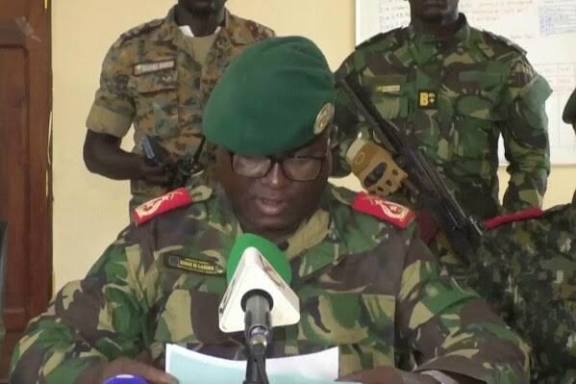
The capital, Bissau, remained tense as armed soldiers patrolled the presidential palace area, where heavy gunfire had echoed on Wednesday during the coup. Residents moved cautiously around the main road leading to the palace.
General N’Tam took his oath at the military headquarters, announcing that he had been sworn in to lead the High Command. Surrounded by heavily armed soldiers, he declared the military’s actions necessary “to block operations that aimed to threaten our democracy.”
The takeover was announced by a group of officers who said they had assumed “total control” of the country and halted the electoral process as Guinea-Bissau awaited the results of last Sunday’s presidential poll. Embaló, who sought a second term, had been widely tipped to win.
N’Tam, who has long served as army chief of staff and is believed to have had a close working relationship with Embaló, insisted that the military possessed “sufficient evidence” to justify the operation.
Guinea-Bissau, located between Senegal and Guinea, has experienced four successful coups and several attempted coups since independence in 1974.
On Wednesday, General Denis N’Canha, head of the presidential military office, said the army acted after uncovering a plot “involving national drug lords,” including “weapons smuggled into the country to alter the constitutional order.”
The military suspended all media programming, froze the electoral process, imposed a curfew, and closed land, air, and sea borders. General Lassana Mansali announced on Thursday that borders had been reopened.
President Embaló is reportedly being held at the general staff headquarters and is said to be “well treated,” according to military sources.
The Economic Community of West African States (ECOWAS) condemned the coup in strong terms, reiterating its zero tolerance for unconstitutional changes of government.
The United Nations Secretary-General António Guterres also expressed “deep concern” over the development, while former colonial power Portugal called for restraint and urged all sides to avoid violence.
Rights groups expressed worry over the suspension of media operations. Reporters Without Borders warned that restricting press access during the crisis was a “grave attack on the public’s right to information.”
Guinea-Bissau, one of the world’s poorest nations, has long struggled with political instability and is frequently cited as a transit point for cocaine trafficking from Latin America to Europe.